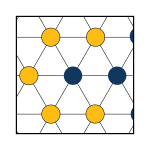

cubic#
- libcasm.xtal.prims.cubic(
- a: float | None = None,
- occ_dof: list[str] = ['A', 'B'],
- local_dof: list[DoFSetBasis] = [],
- global_dof: list[DoFSetBasis] = [],
- occupants: dict[str, Occupant] = {},
- title: str = 'prim',
Construct a simle cubic Prim
- Parameters:
a (Optional[float] = None) – Specify the cubic lattice parameter \(a\).
occ_dof (list[str] = ["A", "B"]) – Labels (‘orientation names’) of occupants allowed on the basis site. The values may either be (i) the name of an isotropic atom (i.e. “Mg”) or vacancy (“Va”), or (ii) a key in the occupants dictionary (i.e. “H2O”, or “H2_xx”). The names are case sensitive, and “Va” is reserved for vacancies.
local_dof (list[DoFSetBasis]=[]) – Continuous DoF allowed on the basis site. No effect if empty.
global_dof (list[DoFSetBasis]=[]) – Global continuous DoF allowed for the entire crystal.
occupants (dict[str, Occupant]=[]) –
Occupantallowed in the crystal. The keys are labels (‘orientation names’) used in the occ_dof parameter. This may include isotropic atoms, vacancies, atoms with fixed anisotropic properties, and molecular occupants. A seperate key and value is required for all species with distinct anisotropic properties (i.e. “H2_xy”, “H2_xz”, and “H2_yz” for distinct orientations, or “A.up”, and “A.down” for distinct collinear magnetic spins, etc.).title (str="prim") – A title for the prim. When the prim is used to construct a cluster expansion, this must consist of alphanumeric characters and underscores only. The first character may not be a number.
- Returns:
prim – A simple cubic Prim
- Return type: